The world is on fire

The world is on fire
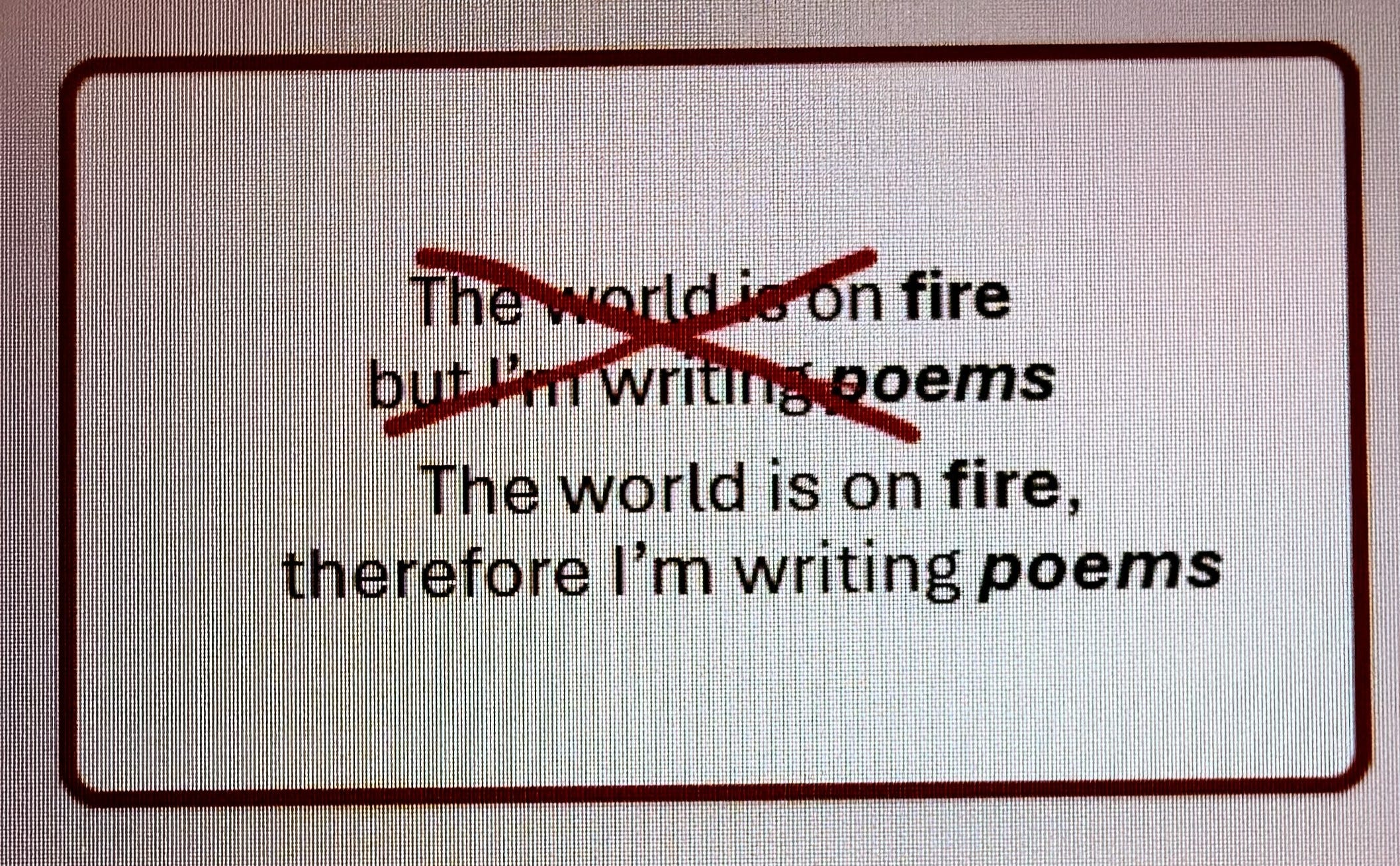
The world is on fire,
but I’m writing poems.
No, scratch that.
The world is on fire.
Therefore I’m writing poems.
Thanks to Tolstoy, we know we don’t want to read about a world that is happy, balanced, fair and rosy-cheeked and sweet-smelling. But we all rush to read the next instalment of a world gone crazy, imploding or exploding. Quite literally.
The main reason for this, psychologists and critics will say, is that such reading allows us to encounter destruction and trauma from a safe place. We can escape it the moment it gets too much for us to handle. And get back to it, or not, whenever it pleases us. And even though it’s an unhappy and destructive world we read about or observe in paintings, experience in songs and movies, we know we can get rid of it with a simple click or turn or the page.
This is one of the reasons we tell stories to children from an early age. Stories let them encounter situations, feelings and experiences that they may meet later in life, thus preparing them to better process these encounters. It makes them more empathetic and sympathetic towards other people and their destinies.
In theory.
When disaster finally arrives, everything changes. Suddenly we become aware that, yes, all those books and songs were right, it really is horrific, but we somehow didn’t quite believe it. Or, rather, we believed it with our mind but not our heart.
Sometimes, we feel that maybe art misled us. It wasn’t harsh enough, brutal enough. We may have lost the emotional or mental space to process how horrific people can be towards each other, how anyone in their right mind could look at a hurt or dead child, a crying child, a hungry child, a wan child and only see a target or mitigation of a future disaster.
Once again, in those moments, we turn to art. This time we don’t need processing; we need escape. And to be able to escape from humanity, we turn to humanity transformed into art. Because art is never only personal — it is communal. Even when made in solitude, it becomes a shared shelter, a place where we hold one another upright when the world tilts. To stay sane, we turn disaster into humour, we turn to dancing, we turn to romance.
All these types of art have their place. They are the tools we reach for depending on our need. It may be humour; it may be raw pain.
Whatever you do, keep that toolbox filled with all sorts of art. You’ll need them one day.
Particularly now. As Toni Morrison says:
‘This is precisely the time when artists go to work. There is no time for despair, no place for self-pity, no need for silence, no room for fear.’
So, go fill that toolbox!
Go use it!
Go dance
!